
Inventory overview
Published
Inventory → Inventory is the business view of your stock: one row per product, across the selected warehouse.
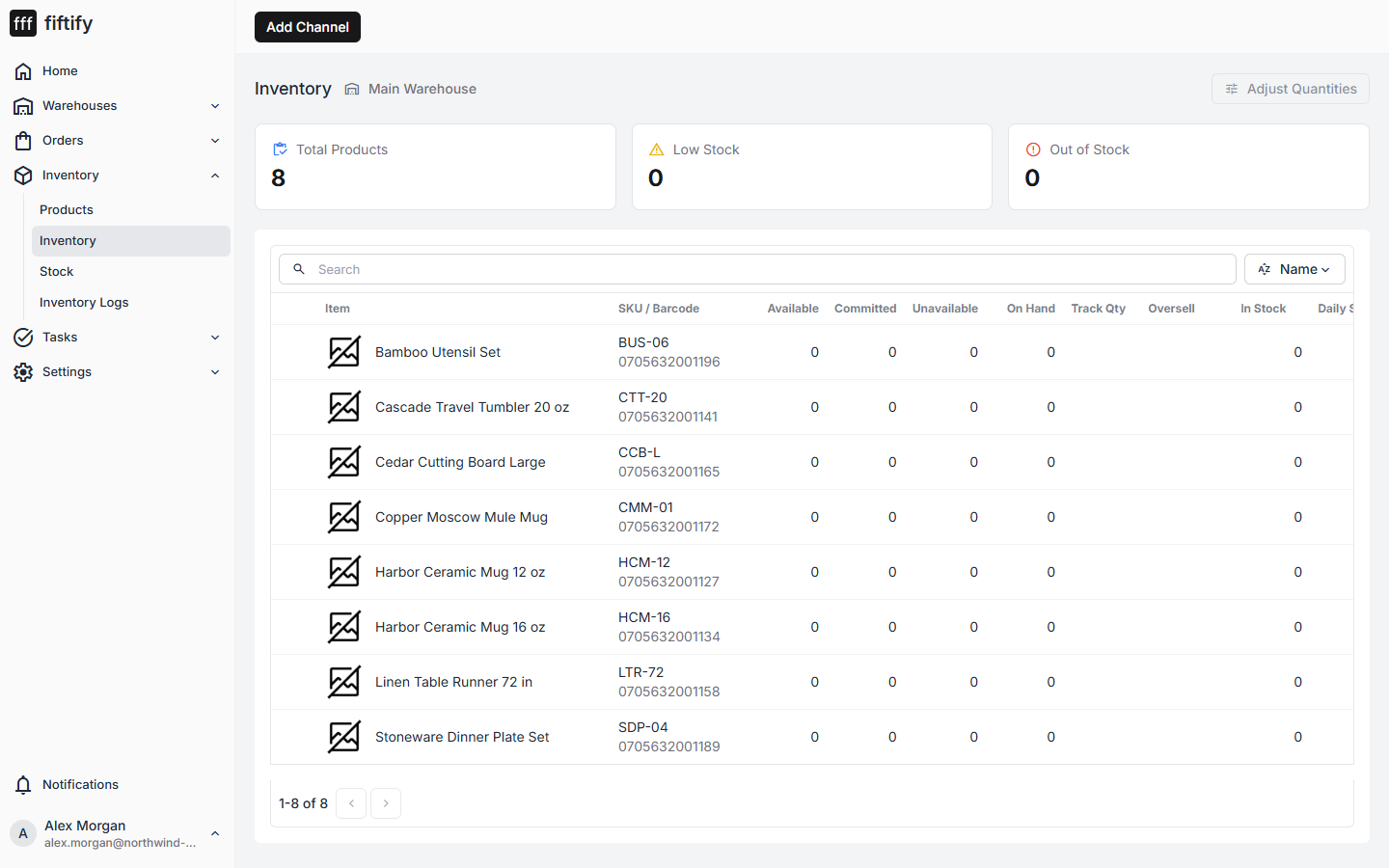
Three tiles sit above the table — Total Products, Low Stock, and Out of Stock — the same counts the warehouse dashboard reports.
The four quantities
Section titled “The four quantities”Every product carries four numbers, and they answer different questions:
| Number | Meaning |
|---|---|
| Available | Free to sell right now |
| Committed | Spoken for by orders that have not shipped |
| Unavailable | Present but not sellable — damaged, quarantined |
| On Hand | Physically in the building: available + committed + unavailable |
The one that catches people out is committed. Stock can be on hand and still not sellable, because it is already promised to an order sitting in the pick queue.
Reorder signals
Section titled “Reorder signals”The columns to the right turn those quantities into decisions:
- Daily Sales — recent rate of sale
- Days to Order — how long before you must place a purchase order
- Estimated Stockout / Stockout Date — when you run out at the current rate
- Lead Time — the supplier’s quoted days, from their record
- Incoming — units already on their way in
- MOQ, Supplier, Supplier SKU, Supplier Price — what ordering will cost
These are only as good as their inputs: a supplier with a lead time of 0 days produces optimistic advice. Fill lead times in properly — see suppliers.
The thresholds that decide when a product counts as running low or overstocked are set once, company-wide, under Settings → Insights.
Track Qty and Oversell
Section titled “Track Qty and Oversell”Track Qty marks whether Fiftify counts this product at all. Products with tracking off are deliberately excluded from stock maths — and from the inventory tiles, so a product can be absent from the counts without being missing.
Oversell allows a channel to keep selling past zero, for made-to-order or drop-shipped goods.
Adjusting quantities
Section titled “Adjusting quantities”Adjust Quantities records a correction against a product — a count that disagrees, breakage, a write-off. Adjustments are logged with a reason and an author rather than silently overwriting the number; the trail lands in the inventory log.
A count that disagrees is better settled with a cycle count than with an adjustment: the count records what was found and by whom, and applies the change only once somebody has approved it.
Where the stock physically sits is the next page: stock by bin.