
Inventory logs
Published
The inventory log is the answer to “why is this number what it is”. Every change to stock lands here, with what caused it and who was responsible.
Inventory → Inventory Logs, scoped to the warehouse in the header.
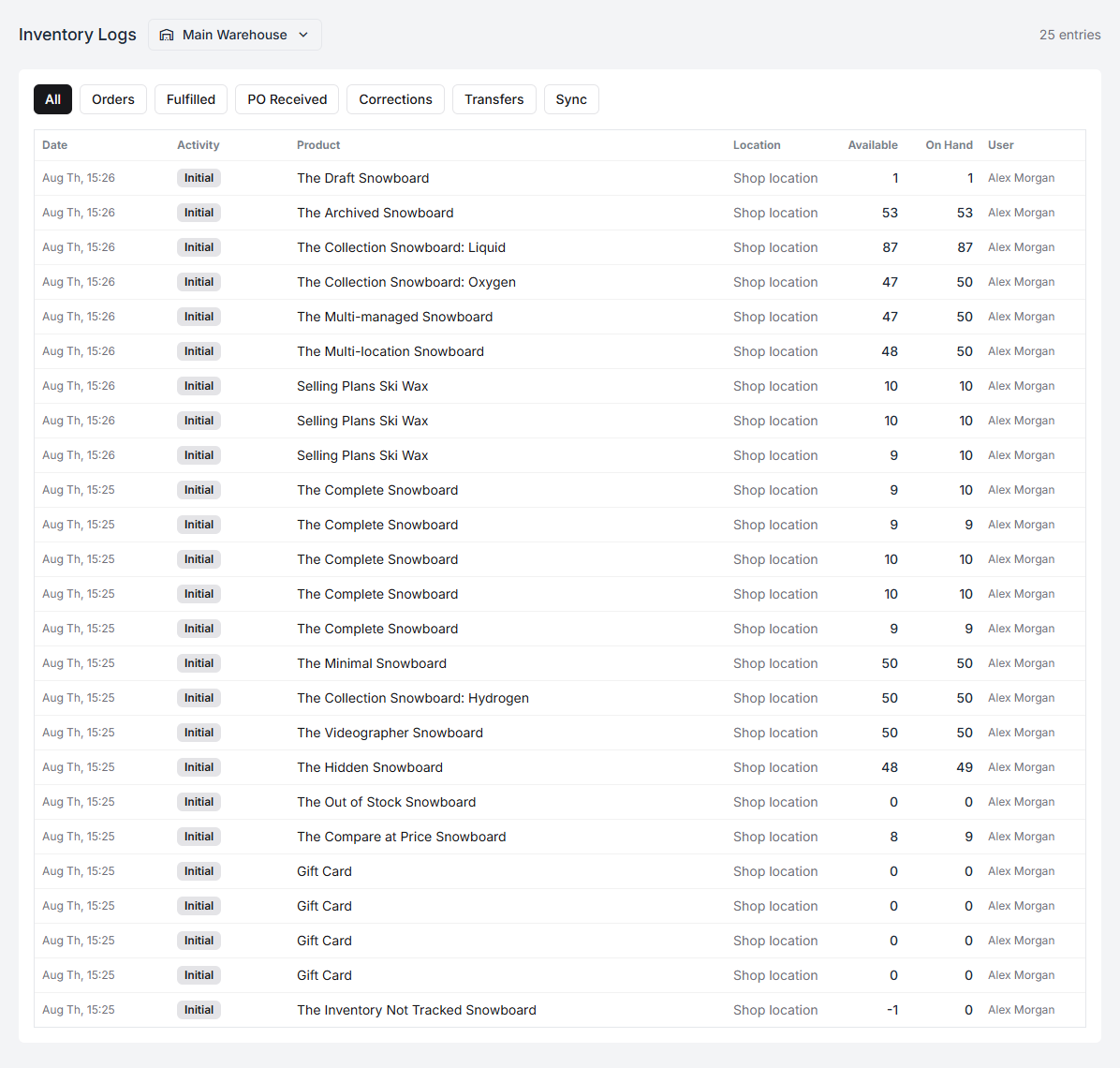
The columns
Section titled “The columns”| Column | What it is |
|---|---|
| Date | When it happened |
| Activity | What caused the change |
| Product | What moved |
| Location | Where it moved |
| Available | The available figure after the change |
| On Hand | The on-hand figure after the change |
The last two are the reason this screen is worth reading rather than skimming. They are running balances: pick any row and you can see what the stock was at that moment, without adding anything up.
The filters
Section titled “The filters”All · Orders · Fulfilled · PO Received · Corrections · Transfers · Sync
Each maps to a reason stock moved:
- Orders — units committed when an order arrived.
- Fulfilled — units deducted when an order shipped.
- PO Received — a delivery counted in.
- Corrections — manual adjustments and approved cycle counts.
- Transfers — stock moving between warehouses.
- Sync — a change that came from a connected channel.
Corrections is the filter to open first when a number is wrong. It is the short list of times a human overrode what the system believed, and the explanation is usually in it.
Sync is the second. A channel that changed a quantity of its own accord — an edit in a Shopify admin, an adjustment in an eBay listing — shows up here rather than as a mystery.
Reading a discrepancy
Section titled “Reading a discrepancy”When a count disagrees with the system, work backwards:
- Filter to the product and find the last row you believe.
- Read forwards from there. The first row that looks wrong is the event to investigate.
- Check who is on it. Most discrepancies are a real action recorded correctly and understood differently — a return put back to the wrong bin, a transfer received twice.
What it is not
Section titled “What it is not”The log records stock movement, not intent. It will tell you that forty units left a bin at 14:20 and who did it; it will not tell you why they thought that was right. For that, the order, the task, or the person is the source.
Related
Section titled “Related”- Stock by bin — where the numbers live.
- Cycle counts — how a disagreement gets settled.
- A product’s own History tab, which is the same idea for one product — see the product page.