
Cycle counts
Published
A cycle count checks that what Fiftify says is in a bin is what is actually in it. Unlike a full stocktake, it covers a handful of bins at a time, so it can happen on a normal working day rather than a shut Sunday.
Inventory → Cycle Counts lists them, filtered by All, Planned, In Progress, and Completed.
Creating one
Section titled “Creating one”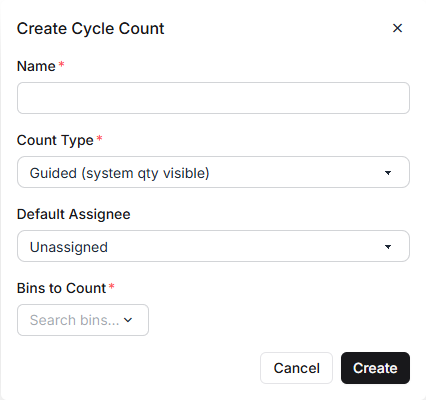
| Field | What it is |
|---|---|
| Name | What this count is. “Pick face A, week 34” beats “Count 12”. |
| Count Type | Guided or Blind |
| Default Assignee | Who counts, if not decided per bin |
| Bins to Count | Search and pick the bins |
Every product with stock in the chosen bins becomes a line to count.
Guided or blind
Section titled “Guided or blind”Guided (system qty visible) shows the counter what Fiftify expects. It is faster, and it is the right choice when you are verifying rather than investigating.
Blind (recount from scratch) hides the expected number. The counter writes down what they see, with nothing to anchor to.
Blind is slower and it is the honest one. Told to expect 48, a person who counts 47 recounts and finds 48. Told nothing, they write 47 — and 47 might be the truth you were looking for. Use blind wherever the numbers have already gone wrong once.
Counting
Section titled “Counting”The count is worked bin by bin, and each line moves through its own states:
| State | What it means |
|---|---|
| Pending | Not counted yet |
| Counted | A number has been submitted |
| Verified | Reviewed and accepted |
| Adjusted | The counted number has been written into stock |
| Rejected | The count was not believed; stock unchanged |
The parent count moves to In Progress as soon as the first line is counted, and records who counted each line and when.
Variance
Section titled “Variance”Each counted line shows Expected, Counted, and Variance — counted minus expected. Zero is the boring, good answer.
A variance is not automatically applied. It is a claim about a shelf, and somebody decides whether to believe it:
- Approve writes the counted quantity into stock. Committed and unavailable units are preserved, and the available figure absorbs the difference.
- Reject leaves stock exactly as it was. The count is on record as rejected.
Rejecting is the right answer more often than people expect. A variance of −40 on a fast mover in the middle of a picking shift is more likely a timing artefact than forty missing units — the picker had them in a tote while the counter was at the bin.
Completing
Section titled “Completing”Once every line has been dealt with, the count is completed and its date recorded. It stays on the list as a record of what was checked, by whom, and what was found.
Building a habit
Section titled “Building a habit”Counting everything once a year finds problems eleven months late. A short weekly count of the bins that matter finds them the same week:
- Fast movers first. They are touched most, so they drift most.
- Anything a picker reported short. A short pick is a count that already disagreed with reality — see short picks and other problems.
- High-value items, on a fixed schedule. Not because they drift more, because they cost more when they do.
- Bins nobody has touched in months. Nothing there should have changed, so anything that did is worth understanding.
Where the results show up
Section titled “Where the results show up”Approved counts change bin stock immediately, which flows into the product’s warehouse totals, the channel quantities that get pushed out, and the low-stock signals on the warehouse dashboard. The change appears in the inventory log with the cycle count as its reason — see stock by bin.