
Productivity
Published
Warehouses → Productivity answers a narrower question than the dashboard: how much work got done, and by whom.
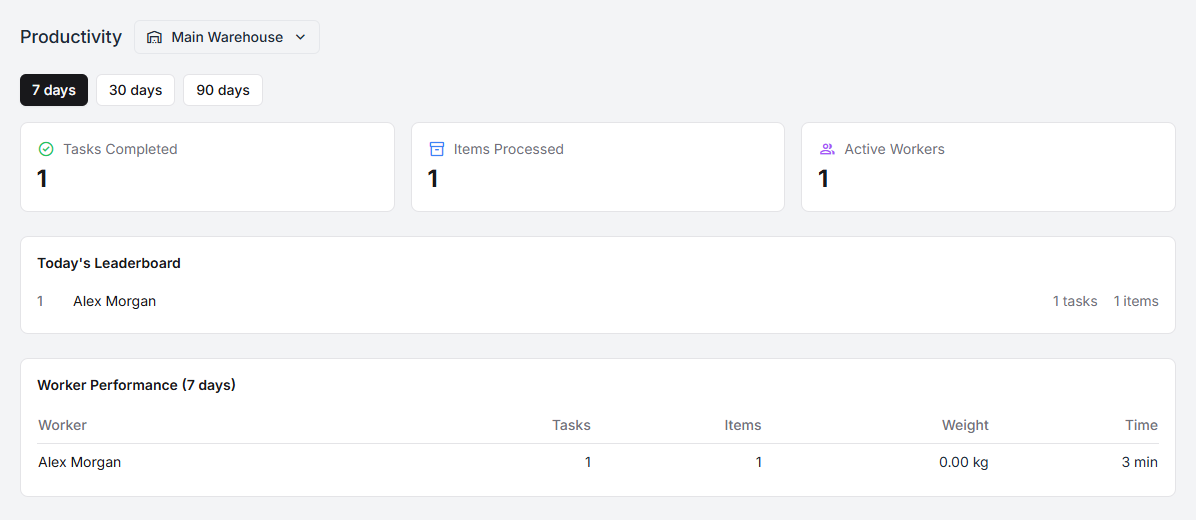
The warehouse picker and the period — 7 days · 30 days · 90 days — sit at the top. The windows are longer than the dashboard’s on purpose: one person’s output on one afternoon is noise.
The three headline numbers
Section titled “The three headline numbers”| Tile | What it counts |
|---|---|
| Tasks Completed | Warehouse tasks finished in the period |
| Items Processed | Individual units handled across those tasks |
| Active Workers | People who completed at least one task |
Tasks and items answer different questions. Ten tasks of one item each is a very different day from one task of a hundred, and only the item count tells them apart.
Today’s leaderboard
Section titled “Today’s leaderboard”A ranking of who has done what today, with tasks and items per person.
Used well, this is a live view for a supervisor mid-shift — who is free, who is buried. Used badly, it is a stick. Two things are worth saying out loud to a team before it goes on a wall: a picker walking a long aisle is not slower than one working a pick face, and a packer wrestling one awkward order is not idle.
Worker performance
Section titled “Worker performance”The table below covers the whole selected period:
| Column | What it is |
|---|---|
| Worker | The person |
| Tasks | Tasks completed |
| Items | Units handled |
| Weight | Total weight moved |
| Time | Time spent on those tasks |
Weight is where warehouse work stops being interchangeable. Two hundred units of table linen and two hundred units of stoneware are the same item count and very different days.
Time is measured from when a task was started to when it was completed, so it includes the walk, the scan, and the wait. It is a measure of the task, not of the person’s effort — a task that sat paused half the afternoon reads as slow.
What it is good for
Section titled “What it is good for”- Working out how many people a peak week needs, from what a normal week costs.
- Spotting a task type that always takes longer than it should — usually a layout problem, not a people problem.
- Splitting a shift’s work more evenly tomorrow than it went today.
What it is not
Section titled “What it is not”It is not a record of hours worked, and it is not a payroll report. It counts completed warehouse tasks in one warehouse. Someone who spent the morning receiving a container and the afternoon fixing a rack shows up as half a day of work, because half of what they did was never a task.